

How to Write Funeral Wreath Eulogies
In Hong Kong, sending a condolence wreath (also known as a flower basket) to express mourning and respect for the deceased is a very important part of traditional funeral rites. However, facing such a solemn and禮儀-conscious occasion, many people feel anxious about not knowing how to write eulogies, how to choose appropriate titles, or even how to adhere to different religious formats, fearing they might inadvertently cause offense. We understand these concerns, which is why we have specially prepared this "Guide to Writing Condolence Wreath Eulogies." The aim is to provide you with a clear and practical reference, so that when you express your condolences, you can do so appropriately, and say goodbye with peace of mind.
This article will gradually guide you through the essentials of writing condolence wreath eulogies, based on the closeness of your relationship with the deceased, helping you to master the etiquette with ease.
I. For Friends and Colleagues: Expressing Respect and Sorrow
Sending a condolence wreath to friends or colleagues primarily expresses respect and sorrow for the deceased, and condolences to the family. Generally, common and appropriate honorifics are used for these relationships.
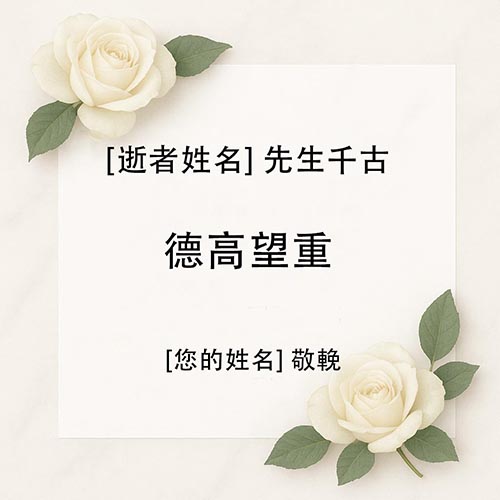
Opening Line (to the Deceased):
- **For Male Deceased:**
[Deceased's Name] Mr. Qian Gu (千古)[Deceased's Name] Brother / My Brother Qian Gu (千古)(if the relationship is closer)
- **For Female Deceased:**
[Deceased's Name] Ms. Ling You (靈右)[Deceased's Name] Mrs. Ling You (靈右)[Deceased's Name] Sister / My Sister Ling You (靈右)(if the relationship is closer)
Middle Section (Four-Character Eulogy):
- **Common for Males:**
哲人其萎 (A sage has passed)、儀型萬方 (A model for all)、碩德貽徽 (Great virtue leaves its mark)、典型足式 (A perfect example)、福壽全歸 (Returned with blessings and longevity)音容宛在 (His/Her image remains)、德高望重 (Highly virtuous and respected)
- **Common for Females:**
懿範長存 (Her noble example lives on)、巾幗典範 (A female paragon)、淑德流芳 (Her virtue spreads fragrance)、瑤池赴宴 (Attending a banquet in the Jade Pool - refers to a female's passing)音容宛在 (His/Her image remains)、德高望重 (Highly virtuous and respected)
- **General:**
音容宛在 (His/Her image remains)、德高望重 (Highly virtuous and respected)、遽返道山 (Suddenly returned to the Dao mountain)、魂歸蓬島 (Soul returned to Penglai Island)、永垂不朽 (Eternal and immortal)高山仰止 (Highly esteemed)、遽歸道山 (Suddenly returned to the Dao mountain)、英靈不朽 (Heroic spirit immortal)
Closing Line (Sender):
[Your Name] Respectfully CondolesJunior [Your Name] Respectfully Condoles(If you are a junior to the deceased)[Company/Organization Name] Respectfully Condoles(On behalf of a company)[Your Name] with Husband/Sons/Daughters Respectfully Condoles(On behalf of the family)[Your Name] and Family Respectfully Condoles(On behalf of the whole family)
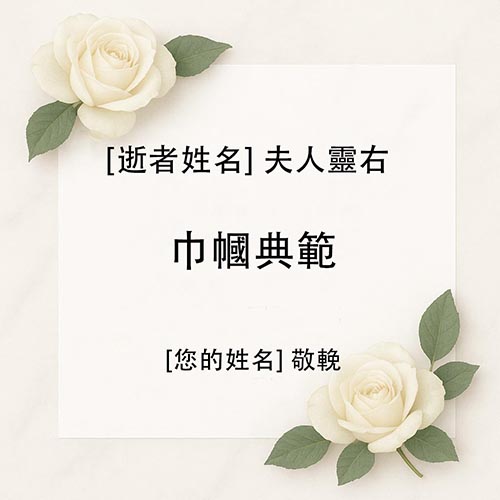
Examples:
Example 1: For a Colleague's Father
- Opening Line:
Mr. [Colleague's Father's Name] Qian Gu (千古) - Eulogy:
德高望重 (Highly virtuous and respected) - Closing Line:
[Your Name] Respectfully Condoles
Example 2: For a Female Friend
- Opening Line:
Ms. [Friend's Name] Ling You (靈右) - Eulogy:
音容宛在 (Her image remains) - Closing Line:
[Your Name] Respectfully Condoles
Example 3: Company Sending to a Client
- Opening Line:
Mr. [Client's Name] Qian Gu (千古) - Eulogy:
高山仰止 (Highly esteemed) - Closing Line:
[Your Company Name] Respectfully Condoles
II. For General Relatives: Expressing Kinship and Respect
This category covers a broader range of relatives, such as uncles, aunts, cousins, in-laws, etc. The titles and honorifics need to accurately reflect the blood or marital relationship while maintaining decorum and respect.
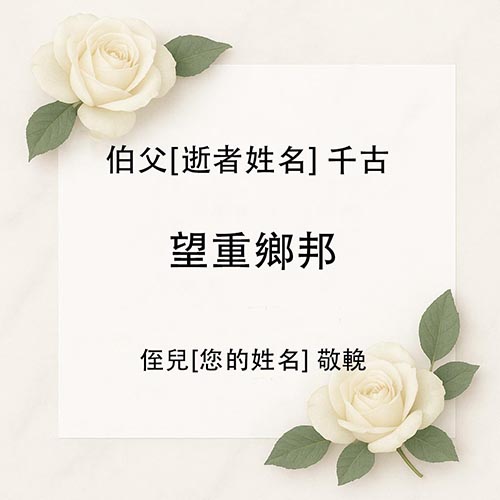
Opening Line (to the Deceased):
- **Elder Relatives (Male):**
[Title, e.g., Paternal Uncle / Maternal Uncle / Aunt's Husband / Maternal Uncle] [Deceased's Name] Qian Gu (千古)[Deceased's Name] Fu Jun (府君) Qian Gu (千古)(More formal usage)
- **Elder Relatives (Female):**
[Title, e.g., Paternal Aunt / Maternal Aunt / Maternal Uncle's Wife / Aunt] [Deceased's Name] Ling You (靈右)[Deceased's Name] Mrs. Ling You (靈右)
- **Peer Relatives:**
Elder Brother / Younger Brother / Paternal Cousin / Maternal Cousin [Deceased's Name] Qian Gu (千古)(Male)Elder Sister / Younger Sister / Paternal Cousin / Maternal Cousin [Deceased's Name] Ling You (靈右)(Female)
- **Junior Relatives:**
Esteemed Nephew / Esteemed Grandnephew [Deceased's Name] Painfully Condoles(Elder to male junior)Esteemed Niece / Esteemed Grandniece [Deceased's Name] Painfully Condoles(Elder to female junior)
Middle Section (Four-Character Eulogy):
- **Male Elders:**
哲人其萎 (A sage has passed)、德高望重 (Highly virtuous and respected)、長逝音容 (His/Her image gone forever)、望重鄉邦 (Respected in his homeland)、典範常昭 (His example shines forever)
- **Female Elders:**
懿範長存 (Her noble example lives on)、母儀足式 (A perfect maternal example)、淑德流芳 (Her virtue spreads fragrance)、駕返瑤池 (Returned to the Jade Pool)、彤管流芳 (Her virtuous deeds are recorded)
- **Peers:**
痛失知己 (Lost a dear friend)、情深手足 (Deep sibling affection)、英年早逝 (Died young)(for those who died young)、魂兮歸來 (Soul, come back!)
- **Juniors:**
天妒英才 (Heaven envies his talent)、痛失英才 (Painfully lost a brilliant talent)、悵望音容 (Longing for his/her image)、蘭摧玉折 (Orchid shattered, jade broken - describes a young person's untimely death)
- **General:**
音容宛在 (His/Her image remains)、德範長存 (His/Her virtuous example lives on)、功業長昭 (His/Her achievements shine forever)、世澤流芳 (His/Her family's virtue flows through generations)
Closing Line (Sender):
[Your Title, e.g., Nephew / Grandnephew / Cousin / In-law] [Your Name] Respectfully Condoles[Your Title] [Your Name] with Wife/Sons/Daughters Respectfully Condoles[Your Title] [Your Name] and Family Respectfully Condoles- **Elders to Juniors:**
[Your Name] Painfully Condolesor[Your Title] [Your Name] Condoles(Less often uses "Respectfully")
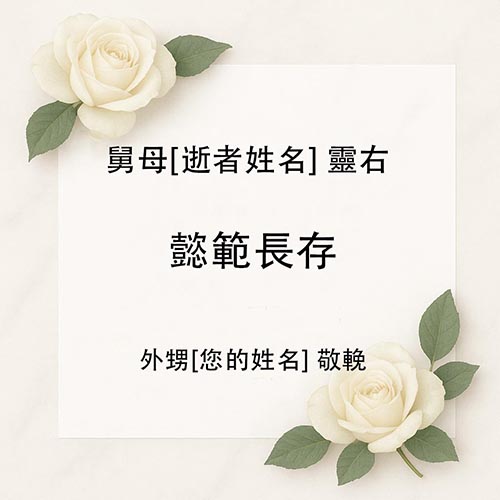
Examples:
Example 1: Nephew to Paternal Uncle
- Opening Line:
Paternal Uncle [Paternal Uncle's Name] Qian Gu (千古) - Eulogy:
德高望重 (Highly virtuous and respected) - Closing Line:
Nephew [Your Name] Respectfully Condoles
Example 2: Elder Female Cousin to Younger Female Paternal Cousin
- Opening Line:
Younger Female Paternal Cousin [Younger Female Paternal Cousin's Name] Ling You (靈右) - Eulogy:
音容宛在 (Her image remains) - Closing Line:
Elder Female Cousin [Your Name] Respectfully Condoles
Example 3: Aunt's Husband to Grandnephew (Untimely Death)
- Opening Line:
Esteemed Grandnephew [Grandnephew's Name] Painfully Condoles - Eulogy:
英年早逝 (Died young) - Closing Line:
Aunt's Husband [Your Name] Painfully Condoles
III. For Family Members (Direct Relatives): Expressing Deepest Grief
Condolence wreaths among direct relatives use words and honorifics that convey the deepest and most unique emotions. Especially in the closing line, "泣叩 (weeping kowtow)" or "泣輓 (weeping condolence)" are often used to express extreme grief. Wreaths from direct relatives are usually low-footed and placed at the very front of the funeral hall.
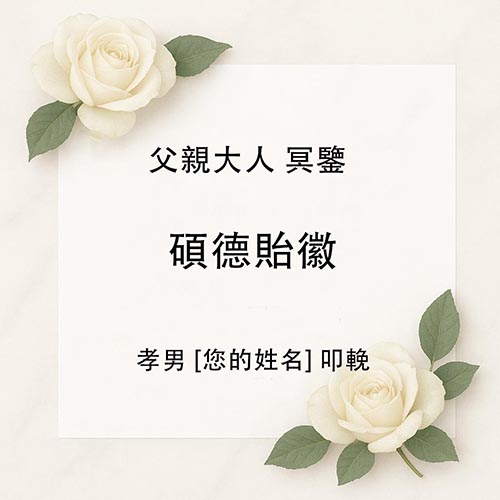
Opening Line (to the Deceased):
- **Husband:**
My Deceased Husband [Name] Qian Gu (千古)My Beloved Husband [Name] Qian Gu (千古)
- **Wife:**
My Beloved Wife [Name] Ling You (靈右)My Dear [Name], Beloved Wife Ling You (靈右)
- **Father:**
Revered Father Qian Gu (千古)Father, May Your Soul Rest in Peace (冥鑒)
- **Mother:**
Revered Mother Ling You (靈右)Mother Ling You (靈右)
- **Paternal Grandfather/Maternal Grandfather:**
Grandfather Qian Gu (千古)Dear Grandfather Qian Gu (千古)
- **Paternal Grandmother/Maternal Grandmother:**
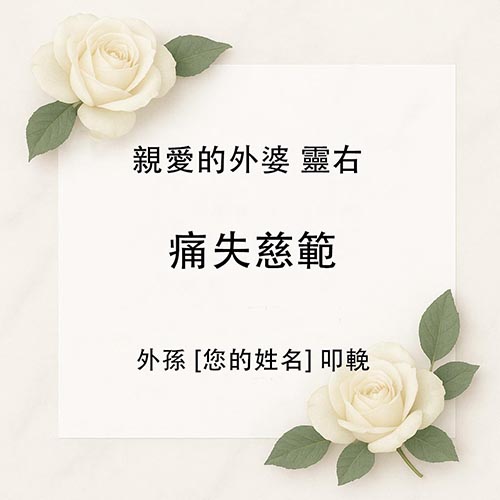
Grandmother Ling You (靈右)Dear Maternal Grandmother Ling You (靈右)
- **Children:**
Beloved Son [Name] Painfully Condoles(For a son)Beloved Daughter [Name] Painfully Condoles(For a daughter)
Middle Section (Four-Character Eulogy):
- **For Male Elders/Husband:**
碩德貽徽 (Great virtue leaves its mark)、典型足式 (A perfect example)、哲人其萎 (A sage has passed)、遽返道山 (Suddenly returned to the Dao mountain)痛失慈嚴 (Painfully lost our benevolent father)(For father)、痛失良夫 (Painfully lost my good husband)(For husband)
- **For Female Elders/Wife:**
懿範長存 (Her noble example lives on)、母儀足式 (A perfect maternal example)、淑德流芳 (Her virtue spreads fragrance)痛失慈範 (Painfully lost our benevolent example)(For mother)、痛失賢妻 (Painfully lost my virtuous wife)(For wife)
- **For Deceased Children:**
英年早逝 (Died young)、天妒英才 (Heaven envies his talent)、痛失所愛 (Painfully lost my beloved)、蘭摧玉折 (Orchid shattered, jade broken - describes a young person's untimely death)
- **General:**
音容宛在 (His/Her image remains)、永垂不朽 (Eternal and immortal)、精神長存 (Spirit lives on)、福壽全歸 (Returned with blessings and longevity)
Closing Line (Sender):
Wife [Your Name] Weeping CondolesHusband [Your Name] Weeping CondolesBeloved Wife [Your Name] Weeping CondolesFilial Son [Your Name] Kowtowing CondolesFilial Daughter [Your Name] Kowtowing CondolesFilial Son [Your Name] Daughter-in-law [Spouse's Name] Kowtowing CondolesFilial Daughter [Your Name] Son-in-law [Spouse's Name] Kowtowing CondolesSon [Your Name] Daughter-in-law [Spouse's Name] Granddaughter [Granddaughter's Name] Kowtowing Condoles(Multiple generations sending together)Daughter [Your Name] with Husband [Spouse's Name] and Son [Son's Name] Kowtowing Condoles- **Parents to Children:**
Father [Your Name] Painfully CondolesMother [Your Name] Painfully CondolesParents [Your Name] Painfully Condole
Examples:
Example 1: Wife to Husband
- Opening Line:
My Beloved Husband [Husband's Name] Qian Gu (千古) - Eulogy:
痛失我愛 (Painfully lost my love) - Closing Line:
Wife [Your Name] Weeping Condoles
Example 2: Son to Father
- Opening Line:
Father, May Your Soul Rest in Peace (冥鑒) - Eulogy:
哲人其萎 (A sage has passed) - Closing Line:
Filial Son [Your Name] Kowtowing Condoles
Example 3: Parents to Deceased Daughter
- Opening Line:
Beloved Daughter [Daughter's Name] Painfully Condoles - Eulogy:
蘭摧玉折 (Orchid shattered, jade broken) - Closing Line:
Parents [Your Name] Painfully Condole
IV. Special Considerations for Christian/Catholic Ceremonies
Compared to traditional Chinese funerals, Christian (Protestant) and Catholic funeral rites differ in eulogies and appellations. They are usually more concise and focus on core concepts of faith, namely "Rest in the Lord" and "Return to the Heavenly Home."
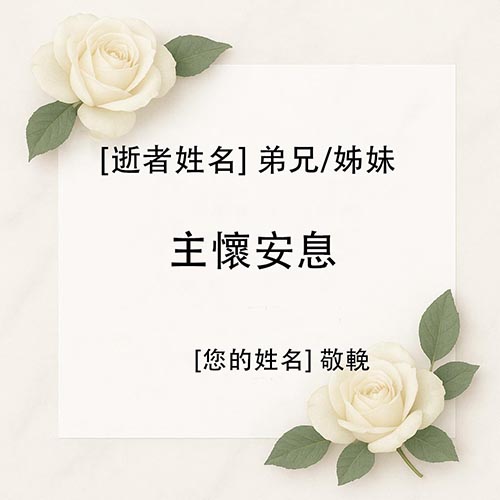
Top Inscription (to the deceased):
[Deceased's Name] Rest in the Lord[Deceased's Name] Spirit Returns to Heaven[Deceased's Name] Brother/Sister, Rest in the Lord(for fellow believers)
Middle Inscription (Four-character eulogy or short phrase):
Rest in the Lord、Rest in Christ、Eternal Life in Heaven、Called by the LordGlorious Return to Heavenly Home、In the Embrace of the Lord
Bottom Inscription (Sender):
Respectfully Inscribed by [Your Name]Respectfully Inscribed by [Church/Organization Name]Respectfully Inscribed by [Your Name] in Christ(also a believer)Respectfully Inscribed by [Your Name] and Family
Examples:
Example One: For a Christian Friend
- Top Inscription:
[Friend's Name] Brother, Rest in the Lord - Eulogy:
Eternal Life in Heaven - Bottom Inscription:
Respectfully Inscribed by [Your Name] in Christ
Example Two: For a Catholic Elder
- Top Inscription:
[Elder's Name] Called by the Lord - Eulogy:
Rest in the Lord - Bottom Inscription:
Respectfully Inscribed by [Your Name]
Example Three: From a Church to a Fellow Believer's Family
- Top Inscription:
[Deceased's Name] Sister, Glorious Return to Heavenly Home - Eulogy:
Lord Grant Eternal Peace - Bottom Inscription:
Respectfully Inscribed by [Church Name]
Knowledge Corner: Why use "Qian Gu" (千古) and "Ling You" (靈右)?
In condolence flower card inscriptions, "Qian Gu" (千古) and "Ling You" (靈右) are two common honorifics with deep cultural roots, each having specific meanings and applicable contexts:
- "Qian Gu" (千古): Eternal Remembrance and Respect
- Meaning: "Qian Gu" means a thousand ages, forever. Used in a eulogy, it expresseseternal remembrance and high respect for the deceased's virtues, achievements, or spirit, believing their influence will last for a long time and never fade. It also carries the heavy meaning of eternal farewell to the deceased.
- Applicability: Traditionally mostly used formale deceased.
- "Ling You" (靈右): Reverent Offering Before the Spirit's Rest
- Meaning: "Ling" refers to the deceased's soul or spiritual tablet; "You" (right) in ancient times conveyed respect and nobility. "Ling You" is an extension meaning before the deceased's spiritual tablet, where the deceased's soul rests in peace. It is a respectful term for the deceased's soul or spiritual tablet, indicating that the eulogy is dedicated to the deceased before their spiritual tablet.
- Applicability: Traditionally mostly used for female deceased. However, in modern society, its usage tends to be flexible, and sometimes it is also used universally for males when a couple passes away together or for brevity, as its tone is softer.
Both terms originate from the traditional Chinese culture's emphasis on views of life and death, spiritual beliefs, and礼仪規範 (ritual norms), and through historical evolution, they have become standard terms for expressing condolences.
Conclusion
Writing condolence flower card inscriptions is an important way to express grief and respect. We hope this comprehensive guide can help you dispel doubts and respond calmly. Please remember, the most important thing is always a sincere heart of remembrance. As long as you carefully choose appropriate appellations and words, you can convey the deepest condolences and blessings.
If you have any further questions or need professional advice when choosing a condolence flower basket or writing an inscription, please feel free to contact uFlowershop's professional consultant team. We are happy to assist you and ensure your intentions are conveyed accurately.
Leave a Reply Cancel Reply